Blog
Fixed Asset Verification Solar Gencos
Discover how fixed asset verification helps solar Gencos reconcile FAR, identify missing and duplicate assets, validate capitalization, reduce operational risks, and improve financial and compliance visibility.
Solar Genco Asset Management: How Fixed Asset Verification Bridges the Gap Between FAR and Physical Reality
India's solar energy sector is expanding rapidly, with generation companies managing large portfolios of solar modules, inverters, transformers, electrical infrastructure, maintenance equipment, and critical spares. As solar plants grow across multiple locations, maintaining accurate and traceable asset records becomes increasingly important.
For Solar GENCOs, asset management is not just about recording investments in financial statements. It is about ensuring that the assets recorded in the Fixed Asset Register (FAR) match what physically exists at the plant, where those assets are located, and whether their status and records remain accurate.
Over time, discrepancies can emerge due to asset replacements, plant expansions, transfers, disposals, maintenance activities, and incomplete record updates. These gaps may affect financial reporting, operational control, audit readiness, and asset lifecycle management.
Fixed Asset Verification provides a structured approach to connect financial records with physical assets. By combining on-site verification, FAR reconciliation, digital tagging, and technology-enabled reporting, Solar GENCOs can gain better visibility into their asset base and identify discrepancies requiring management attention.
In this blog, we explore how fixed asset verification supports solar asset management, improves financial and operational visibility, and helps organizations build a more reliable asset control framework.
Why Fixed Asset Verification Matters for Solar GENCOs
Solar power plants operate across large areas, with assets distributed across module fields, inverter stations, substations, control rooms, warehouses, maintenance facilities, and administrative buildings.
Managing these assets requires coordination between finance, operations, engineering, maintenance, stores, and audit teams. Each department may maintain different records or use different systems, creating the possibility of information gaps.
Common asset management challenges include:
- Differences between the Fixed Asset Register and physical assets.
- Assets recorded under incorrect locations or descriptions.
- Missing or duplicate asset records.
- Replaced equipment that remains active in records.
- Unrecorded physical assets requiring accounting review.
- Limited visibility into maintenance spares and equipment.
- Incomplete asset tagging and movement history.
- Difficulty preparing asset-level evidence for audits and reviews.
These challenges do not necessarily indicate fraud or accounting errors. They represent exceptions that require investigation and reconciliation.
A systematic physical asset verification exercise helps Solar GENCOs identify such exceptions and provide finance and operational teams with reliable information for corrective action.
Financial Records vs. Physical Reality
A Fixed Asset Register provides accounting information about an organization's assets, such as asset numbers, descriptions, capitalization values, depreciation-related details, and locations.
Physical verification answers a different but connected question:
Does the asset recorded in the financial system correspond to an identifiable physical asset at the expected location?
Connecting these two perspectives helps management understand the actual status of its asset portfolio.
What Is Fixed Asset Verification for Solar Power Plants?
Fixed Asset Verification is a systematic process of identifying, inspecting, documenting, and reconciling physical assets against an organization's financial and operational records.
For Solar GENCOs, the process can cover generation equipment, electrical infrastructure, plant machinery, civil assets, vehicles, office equipment, and stores and spares, depending on the agreed scope.
The objective is to establish a reliable record of:
- What assets exist physically.
- Where each asset is located.
- Whether the asset can be matched to the FAR.
- Whether its identification details are accurate.
- Whether discrepancies require further investigation.
- Whether records support financial and operational review.
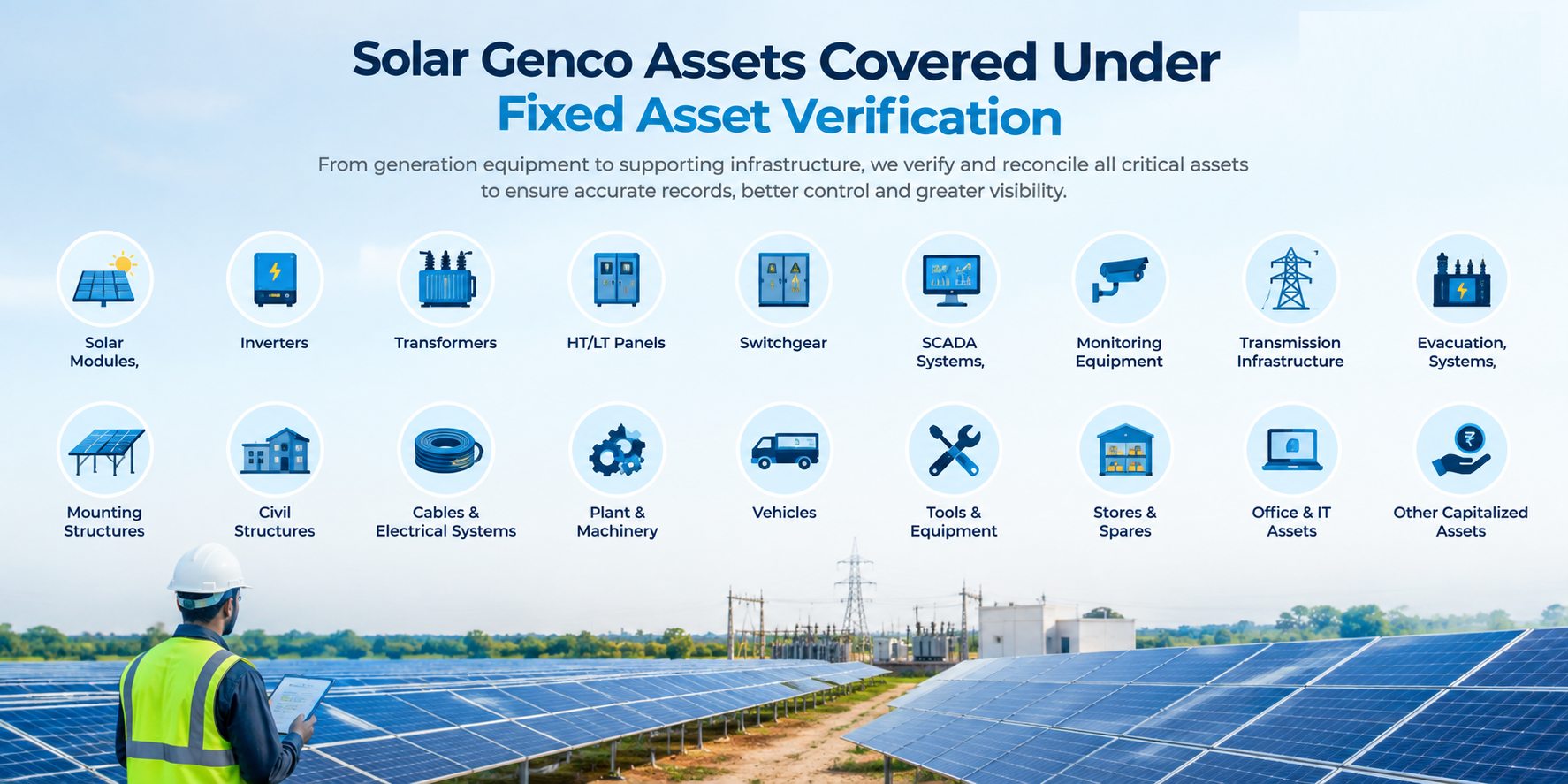
Assets Typically Covered
A solar plant fixed asset verification exercise may include:
- Solar modules and associated structures.
- Inverters and inverter stations.
- Transformers and switchgear.
- HT/LT panels and electrical systems.
- SCADA and monitoring equipment.
- Transmission and evacuation infrastructure.
- Plant and machinery.
- Civil and structural assets.
- Vehicles and maintenance equipment.
- Tools and critical spares.
- Office and IT equipment.
- Other capitalized assets within the agreed scope.
The exact scope depends on the plant's asset register, operational structure, and verification requirements.
7 Key Benefits of Fixed Asset Verification for Solar GENCOs
1. Reconcile the Fixed Asset Register With Physical Assets
One of the primary purposes of fixed asset verification is to identify differences between financial records and assets physically available at the plant.
During verification, field teams can compare the FAR against physical asset information such as:
- FAR number or asset ID.
- Asset description.
- Plant and location.
- Equipment category.
- Manufacturer and model.
- Serial number, where available.
- Physical status.
- Tagging details.
- Relevant capitalization information.
- Verification remarks and supporting evidence.
This comparison helps determine whether assets recorded in the financial system can be physically identified and whether the available physical assets are appropriately reflected in the records.
For example, an inverter may be listed in the FAR under one location while physically installed at another plant or block. Similarly, a transformer may be recorded under an incomplete description that makes identification difficult.
These findings can be reviewed by finance and operations teams to validate records and update information where appropriate.
Business value: FAR reconciliation creates a clearer connection between accounting records and the actual asset base.
2. Identify Missing, Unrecorded, Duplicate, and Ghost Assets
Asset discrepancies are a critical area of review during physical verification.
A structured exercise can help identify different categories of exceptions.
Missing Assets
Assets recorded in the FAR but not located during the verification exercise.
Possible reasons may include:
- Asset transfers.
- Replacement or disposal.
- Incorrect location records.
- Access limitations during fieldwork.
- Incomplete identification details.
A missing asset should be investigated before any accounting or operational conclusion is reached.
Unrecorded Assets
Physical assets identified at the site that cannot be matched to the available FAR or related records.
These findings may require a review of capitalization, procurement, commissioning, transfer, or record-maintenance documentation.
Duplicate Records
Multiple records that may represent the same physical asset or potentially duplicate entries in the financial system.
Such exceptions require validation using asset IDs, serial numbers, descriptions, supporting documents, and accounting records.
Ghost Assets
Assets appearing in records without sufficient physical evidence or traceability.
The term should be used carefully. A lack of physical identification does not automatically establish that an asset does not exist or that wrongdoing has occurred.
Business value: Discrepancy identification helps management prioritize investigation, reconciliation, and corrective action.
3. Support Capitalization Validation and Financial Reporting
Solar projects involve significant capital expenditure across development, construction, commissioning, expansion, and replacement activities.
As assets are installed and modified, accurate capitalization and record updates become important for financial reporting and asset management.
Physical verification can help identify exceptions such as:
- Equipment installed but not properly reflected in records.
- Assets recorded under potentially incorrect descriptions.
- Replaced equipment that remains listed as active.
- Asset transfers without corresponding location updates.
- Incomplete serial numbers or asset identification details.
- Differences between plant-level records and the central FAR.
Physical verification alone does not establish the correct accounting treatment. Finance teams must review relevant supporting documentation, capitalization policies, and applicable accounting requirements.
However, verified physical information can provide useful evidence for reviewing asset records.
Areas Supported by Verification
- Asset classification review.
- Capitalization record validation.
- Location mapping.
- Replacement and disposal record review.
- Depreciation-related data validation.
- Financial reporting support.
For instance, if a plant has replaced a major electrical component, physical verification may identify that the old equipment is no longer installed while the FAR still contains the original record. This creates an exception for the finance and engineering teams to investigate.
Business value: Physical evidence supports stronger financial record controls and more informed accounting reviews.
4. Improve Asset Location and Movement Tracking
Solar GENCOs may manage assets across multiple plants, warehouses, maintenance areas, and repair facilities.
Equipment can be transferred for maintenance, replacement, project expansion, or operational requirements. If these movements are not properly recorded, the asset's registered location may become inaccurate.
A technology-enabled asset management process can connect:
Asset ID → Tag → Plant → Location → Status → Record
This structure helps teams maintain clearer asset information and investigate location mismatches.
Questions Asset Movement Tracking Can Help Answer
- Where is the asset currently recorded?
- Which plant or block does it belong to?
- Has it been transferred or sent for repair?
- Is the asset active, under maintenance, or retired?
- Does the recorded location match the physical location?
- Is the asset movement supported by relevant documentation?
RFID, QR codes, and barcode-based identification can support asset traceability, depending on the operating environment and implementation design.
The technology does not replace movement authorization or record-maintenance procedures. It helps organizations establish a more consistent identification and tracking framework.
Business value: Better location visibility can support coordination between finance, operations, maintenance, and stores teams.
5. Strengthen Insurance and Due Diligence Readiness
Solar plants contain high-value equipment and infrastructure that may require accurate asset information for insurance reviews, lender requirements, investment assessments, or due diligence.
An asset verification exercise can help organizations review whether:
- Equipment can be physically identified.
- Asset descriptions and locations are accurate.
- Relevant records reflect additions and replacements.
- High-value assets have adequate traceability.
- Asset information supports discussions with insurers and risk teams.
- Exceptions are documented for further review.
Physical verification does not guarantee lower insurance premiums or automatically confirm insurance coverage. Coverage and valuation decisions depend on policy terms, documentation, risk assessments, and other relevant factors.
Nevertheless, a structured asset database can improve the quality of information available to stakeholders.
For organizations involved in acquisitions, refinancing, or portfolio reviews, asset-level verification records can provide useful supporting evidence.
Business value: Improved asset information can reduce uncertainty and support more organized audit, insurance, and due diligence processes.
6. Identify Operational and Maintenance Risks
Fixed Asset Verification is not limited to financial reconciliation. When field teams inspect and identify assets, they may also observe information gaps relevant to operations and maintenance.
Examples include:
- Equipment with missing identification tags.
- Assets that cannot be matched to available records.
- Damaged equipment requiring technical review.
- Equipment lying idle or awaiting repair.
- Unidentified maintenance spares.
- Inconsistent asset descriptions.
- Equipment recorded at the wrong location.
- Assets requiring further engineering assessment.
These observations should be documented and routed to the relevant teams. A physical verification team should not independently make technical judgments about equipment safety or operational performance unless that is included in the engagement scope and conducted by qualified personnel.
For example, an observation that an inverter is physically present but marked as inactive in the records can trigger a review by the maintenance and operations teams.
Business value: Asset verification can generate operational observations that support better maintenance coordination and lifecycle management.
7. Improve Audit and Compliance Visibility
Solar GENCOs may undergo internal audits, statutory audits, lender reviews, insurance assessments, or investment-related due diligence.
Stakeholders may require supporting evidence regarding asset existence, identification, location, and status.
A structured verification process can generate reports such as:
- Asset-wise verification records.
- FAR reconciliation statements.
- Plant-wise asset summaries.
- Missing and excess asset reports.
- Duplicate record exception reports.
- Asset tagging status.
- Location mismatch reports.
- Photographic evidence, where required.
- Management exception reports.
- Corrective action tracking.
The specific reports depend on the scope, client requirements, and information available.
Digital records can help reduce reliance on fragmented spreadsheets and manual explanations, while creating a more consistent evidence trail for review.
Business value: Better documentation supports audit readiness and enables management to review exceptions systematically.
Solar Genco Fixed Asset Verification Process
A reliable verification program combines fieldwork, data analysis, technology, and reconciliation.
Step 1: FAR Data Collection and Analysis
The process begins with collecting relevant records, which may include:
- Fixed Asset Register.
- Plant-wise asset lists.
- Asset master data.
- Location details.
- Relevant capitalization information.
- Previous verification reports.
- Asset movement or replacement records, where available.
The data is reviewed to understand the asset population, identify potential duplicates, and plan the verification methodology.
Step 2: Site Planning and Asset Mapping
The verification team plans the fieldwork based on plant locations, asset categories, site accessibility, and the agreed scope.
Assets can be grouped by areas such as:
- Solar module fields.
- Inverter stations.
- Substations.
- Control rooms.
- Warehouses.
- Maintenance facilities.
- Administrative areas.
A defined methodology helps teams maintain consistency across multiple sites.
Step 3: Physical Asset Verification and Tagging
Field teams identify assets and capture relevant information against the available records.
Depending on the project requirements, the process may include:
- Asset identification.
- Location verification.
- Serial number capture.
- Tag validation.
- Physical status recording.
- Photographic evidence.
- QR, barcode, or RFID tagging.
Tagging methods should be selected based on asset characteristics, environmental conditions, durability requirements, and operational needs.
Step 4: FAR Reconciliation and Exception Identification
The physical verification results are compared against the FAR and other relevant records.
Potential exceptions include:
- Missing assets.
- Unrecorded physical assets.
- Duplicate records.
- Location mismatches.
- Description differences.
- Tagging gaps.
- Replacement or disposal-related discrepancies.
Each exception should be reviewed and classified according to the agreed reconciliation methodology.
Step 5: Reporting and Management Insights
The verification team prepares reports that may include:
- Verified asset summaries.
- Plant-wise reconciliation.
- Exception categories.
- Asset tagging status.
- Location-wise findings.
- Supporting evidence.
- Management observations.
Reports should distinguish verified findings from items requiring further validation.
Step 6: Corrective Action and Closure
The finance, operations, and other responsible teams review the findings and determine the appropriate actions.
These may include:
- Updating asset locations.
- Validating capitalization records.
- Investigating missing assets.
- Reviewing duplicate entries.
- Updating replacement or disposal records.
- Retagging assets.
- Strengthening asset movement procedures.
A defined closure process helps ensure that verification findings lead to measurable improvements rather than remaining as unresolved observations.
Why Technology Matters in Solar Asset Management
Traditional asset verification often relies on spreadsheets, manual notes, and photographs. These methods can become difficult to manage when asset populations are large or distributed across several plants.
Technology can support the verification process by improving data capture, identification, reconciliation, and reporting.
RFID Asset Tagging
RFID technology can help identify and track assets through electronically readable tags.
Potential applications include:
- Asset identification.
- Movement tracking.
- Verification support.
- Location-based asset management.
- Repeat audit efficiency.
RFID suitability depends on the asset's material, tag placement, reading conditions, and operational environment.
QR and Barcode Tagging
QR codes and barcodes provide accessible identification options for many assets.
They can support:
- Unique asset identification.
- Mobile scanning.
- Record retrieval.
- Asset status updates.
- Verification documentation.
The appropriate tagging method depends on the asset type, environmental exposure, and client requirements.
Digital Asset Management Software
A digital platform can help centralize asset data and verification results.
Common capabilities may include:
- Asset master management.
- Mobile field data collection.
- FAR reconciliation.
- Exception reporting.
- Location mapping.
- Asset tagging records.
- Dashboard summaries.
- Evidence management.
Technology should support, rather than replace, the underlying verification methodology and accounting controls.
How TagRoboTech Supports Solar GENCOs
At TagRoboTech, we help organizations improve physical asset visibility through asset verification, FAR reconciliation, asset tagging, and technology-enabled reporting.
Our approach focuses on connecting financial records with physical asset information to help clients identify discrepancies and improve asset control.
Our Key Capabilities
1. Fixed Asset Physical Verification On-site identification and verification of assets across solar plants and associated facilities, based on the agreed scope.
2. FAR Reconciliation Comparison of physical verification findings with the client's Fixed Asset Register to identify mismatches and support record validation.
3. Asset Tagging and Traceability Implementation support for QR codes, barcodes, RFID, or other suitable identification methods.
4. Asset Movement Visibility Support for maintaining asset location and movement records across plants, warehouses, maintenance areas, and designated facilities.
5. Stores and Spares Verification Identification and verification of maintenance spares and inventory items to improve record accuracy and traceability.
6. Technology-Enabled Reporting Structured reports that help finance, operations, audit, and management teams review verification findings and exceptions.
Our Software-Led Approach
TagRoboTech's auditing software supports the capture and organization of field-level asset data, reconciliation activities, and reporting.
Depending on project requirements, technology can help teams:
- Capture asset information digitally.
- Connect assets with identification tags.
- Record locations and status.
- Compare physical findings with FAR records.
- Generate structured reports.
- Support exception tracking.
The objective is to help Solar GENCOs build a repeatable asset control framework rather than treating verification as an isolated annual activity.
Practical Examples of Solar Asset Verification Findings
The following examples illustrate how verification findings can be used for management review.
| Verification finding | Potential implication | Suggested review |
|---|---|---|
| FAR asset not located | Location, transfer, disposal, or record issue | Validate with plant and finance teams |
| Physical asset without FAR match | Possible record or capitalization gap | Review supporting documentation |
| Asset recorded at wrong plant | Inaccurate asset location | Validate and update records |
| Duplicate asset records | Potential duplication in records | Investigate asset identity and accounting entries |
| Missing identification tag | Reduced traceability | Validate and retag where appropriate |
| Replaced equipment still active in FAR | Inaccurate lifecycle information | Review replacement and retirement records |
| Unidentified critical spare | Limited stores visibility | Identify, classify, and reconcile |
These are potential explanations, not automatic conclusions. Each finding requires review based on the evidence and the client's accounting and operational procedures.
The value of verification is measured not only by the number of discrepancies identified, but also by the quality of investigation and corrective action that follows.
Building an Ongoing Asset Control Framework
A one-time physical verification exercise establishes a baseline. However, solar plant assets continue to change throughout their lifecycle.
New equipment is installed, components are replaced, assets are transferred, spares are consumed, and equipment is retired.
Without periodic updates, discrepancies may reappear over time.
Solar GENCOs can strengthen ongoing asset management by implementing:
- Periodic physical asset verification.
- Timely FAR updates.
- Asset tagging during commissioning or capitalization stages.
- Documented asset movement procedures.
- Replacement and disposal controls.
- Plant-wise asset ownership.
- Coordination between finance, operations, and maintenance.
- Exception tracking and closure.
- Periodic management review.
An effective framework should be designed around the organization's asset population, operational processes, technology infrastructure, and risk priorities.
The goal is to maintain asset visibility throughout the lifecycle, not simply to verify assets once.
Conclusion: Improving Solar Genco Asset Visibility Through Verification
As solar generation portfolios expand, reliable asset information becomes increasingly important for financial reporting, operational coordination, and audit readiness.
Fixed Asset Verification helps Solar GENCOs connect the Fixed Asset Register with physical assets across plants, substations, warehouses, and maintenance facilities.
A structured process can support:
- FAR and physical asset reconciliation.
- Identification of missing, unrecorded, and duplicate records.
- Asset location and movement visibility.
- Capitalization-related record validation.
- Asset tagging and traceability.
- Audit and due diligence documentation.
- Operational and maintenance observations.
Technology such as RFID, QR codes, and digital asset management software can further support asset identification, data capture, and reporting.
At TagRoboTech, we focus on helping organizations establish a more reliable and traceable asset information framework through physical verification, FAR reconciliation, tagging, and technology-enabled reporting.
Your financial records should be supported by reliable physical asset information.
If your Solar Genco is looking to improve fixed asset verification, FAR reconciliation, asset tagging, or stores and spares visibility, TagRoboTech can help you explore a structured approach tailored to your plant and asset management requirements.
Frequently Asked Questions (FAQs)
What is fixed asset verification in a solar power plant?
Fixed asset verification is the process of physically identifying and checking solar plant assets against the Fixed Asset Register and relevant records to identify discrepancies and improve asset visibility.
Why is FAR reconciliation important for Solar GENCOs?
FAR reconciliation helps compare financial records with physical assets, identify mismatches, and support accurate asset location, identification, and record validation.
Can RFID and QR codes be used for solar asset tracking?
Yes. RFID and QR codes can support asset identification and traceability. The appropriate solution depends on asset characteristics, site conditions, and operational requirements.
What types of solar assets can be verified?
Verification may include solar modules, inverters, transformers, switchgear, SCADA equipment, plant machinery, civil assets, vehicles, maintenance equipment, and stores and spares, depending on the agreed scope.
How often should Solar GENCOs conduct fixed asset verification?
The frequency should be determined based on asset risk, portfolio size, operational changes, internal controls, and organizational requirements. Periodic verification can help maintain asset record accuracy.
How does TagRoboTech support solar asset verification?
TagRoboTech supports physical asset verification, FAR reconciliation, asset tagging, stores and spares verification, and technology-enabled reporting to improve asset visibility and traceability.